In 2024, I contributed a chapter for “The Unmaking of Them: Clinical Reflections of Boarding School Syndrome “(Duffell, 2025). This explored the complexity of working therapeutically with adults who attended boarding school and the impact that the dislocation in attachment from their parents/ carers may have had into adulthood.
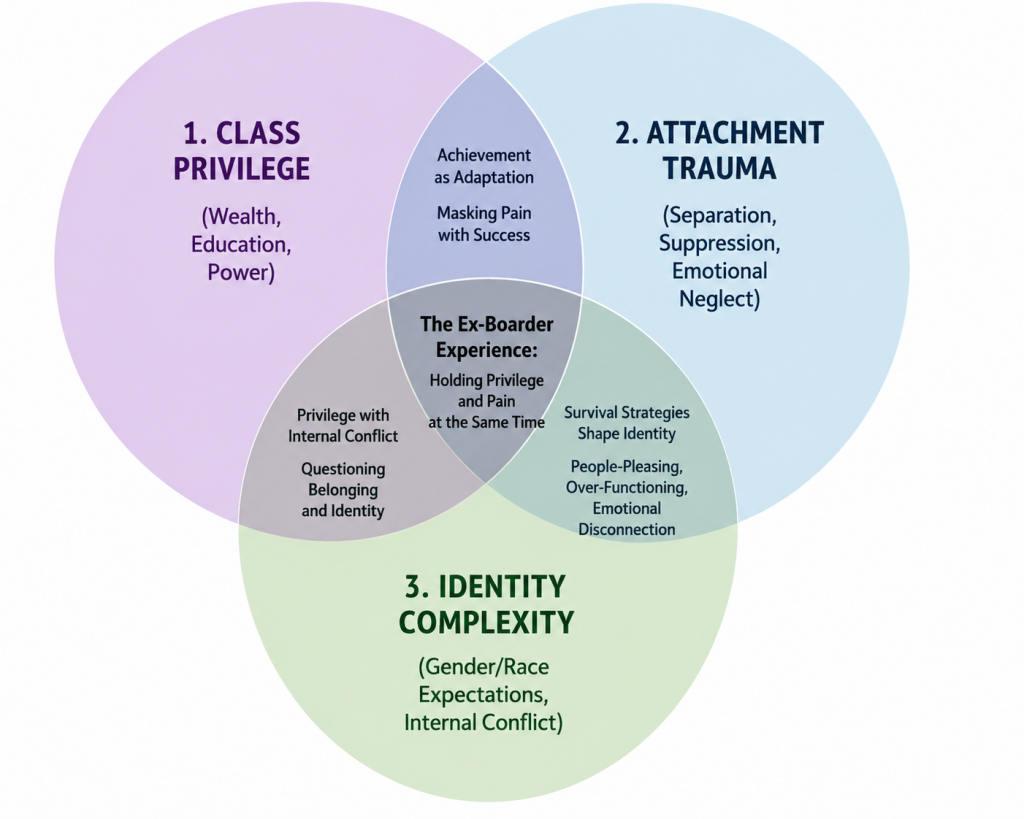
Boarding school is often associated with privilege: educational opportunity, social status and access to influential networks. Yet this can sit alongside a very different psychological experience — being separated from home and primary attachment figures at a young age, learning to suppress vulnerability, and adapting to an institutional environment in which independence and self-reliance may be highly valued.
My work explores the importance of being able to hold these apparently contradictory experiences together.
Drawing on the concept of intersectionality (Crenshaw, 1989), I consider how an individual’s boarding experience may have been shaped not simply by attending a particular type of school, but by the interaction of factors such as gender, social class, ethnicity, sexuality, disability, family circumstances, cultural background and whether they experienced themselves as belonging — or as somehow different from those around them.
This matters because there is no single ex-boarder experience. For one child, boarding may have represented loss, abandonment or a need to become prematurely self-sufficient. For another, it may have offered stability, opportunity or even refuge from a difficult home environment. For many, the reality may contain elements of both and these perceived dichotomies can leave children with a range of emotions that they may not even be able to name or identify.
The clinical framework I developed with psychotherapist Bella Cranmore therefore encourages therapists to look beyond the label of “boarding school syndrome” and become curious about the individual story with their clients: What was the child’s life like before boarding? Why was the child sent away? What did they encounter when they arrived? How did they learn to survive and belong? And how might those adaptations still be influencing relationships, identity and emotional life decades later?
Alongside intersectionality, the framework draws upon the Power Threat Meaning Framework (PTMF;Johnstone & Boyle, 2020), shifting the therapeutic question away from “What is wrong with you?” towards understanding “What happened to you, what did it mean to you, and what did you have to do to survive?”
Perhaps most importantly, this work challenges us to move beyond an either/or understanding of privilege and suffering. A person can have benefited enormously from their education and still have experienced profound attachment rupture or emotional loss. Recognising one does not require us to deny the other. It is within that more nuanced space that a person’s individual story — rather than the assumptions attached to their background — can begin to emerge.
If any of this resonates with your own experience of boarding school, or it helps you recognise its lasting impact on someone close to you, please feel free to contact me to find out more about how I may be able to help.
Refs:
- Collins, S. F. (2025). A clinical framework for nuanced narratives in therapy with ex-boarders. In N. Duffell (Ed.), The unmaking of them: Clinical reflections on boarding school syndrome. Routledge.
- Crenshaw, K. (1989). Demarginalizing the intersection of race and sex: A Black feminist critique of antidiscrimination doctrine, feminist theory and antiracist politics. University of Chicago Legal Forum, 1989(1), 139–167.
- Boyle, M., & Johnstone, L. (2020). A straight talking introduction to the Power Threat Meaning Framework: An alternative to psychiatric diagnosis. PCCS Books.