It is surprisingly easy to become more familiar with what we do not want than with what we do. We do not want to feel anxious, trapped, unsuccessful or alone. We do not want to remain in an unfulfilling job or repeat the same painful patterns. Yet when we have spent a long time responding to difficulty, meeting other people’s expectations or simply trying to keep life functioning, we may struggle to answer the question of what do I actually want?
Our attention naturally gravitates towards what feels wrong or threatening; after all we are primed to fight the legendary sabre-toothed tiger. This can be useful when something needs to change, but it can also leave us constructing our lives around avoidance. We may know what we are trying to escape without having a clear sense of what we are moving towards.
At the same time, we live in a culture of relentless comparison. Social media presents us with carefully curated versions of other people’s achievements, relationships, appearance and apparent certainty. Against these polished images, our own lives can feel ordinary or insufficient. We may become so absorbed in assessing where we fall short that we forget to recognise our own gifts—the qualities, experiences and strengths that cannot be measured by somebody else’s path.
Some strengths are easy to overlook precisely because they come naturally to us – namely our ‘superpowers”. We may not recognise our ability to listen, reassure, organise, create, persevere, notice what others miss or help people feel understood. What feels unremarkable from the inside may be deeply valuable to those around us.
We may also lose sight of what can sustain us. Financial security matters, but meaningful sustenance is about more than income. It includes the relationships, activities, surroundings and ways of living that replenish rather than continually deplete us. Work can be well rewarded and still leave us feeling disconnected. Something comparatively modest may bring a profound sense of vitality, belonging or purpose.
Then there is the question of what we can contribute. In a world that increasingly celebrates individual success, personal status and material acquisition, contribution can sound like another demand to achieve something impressive. But contribution does not have to be grand or publicly recognised. It may lie in the way we care for others, use our experience, create beauty, solve problems, protect what matters or help someone feel less alone.
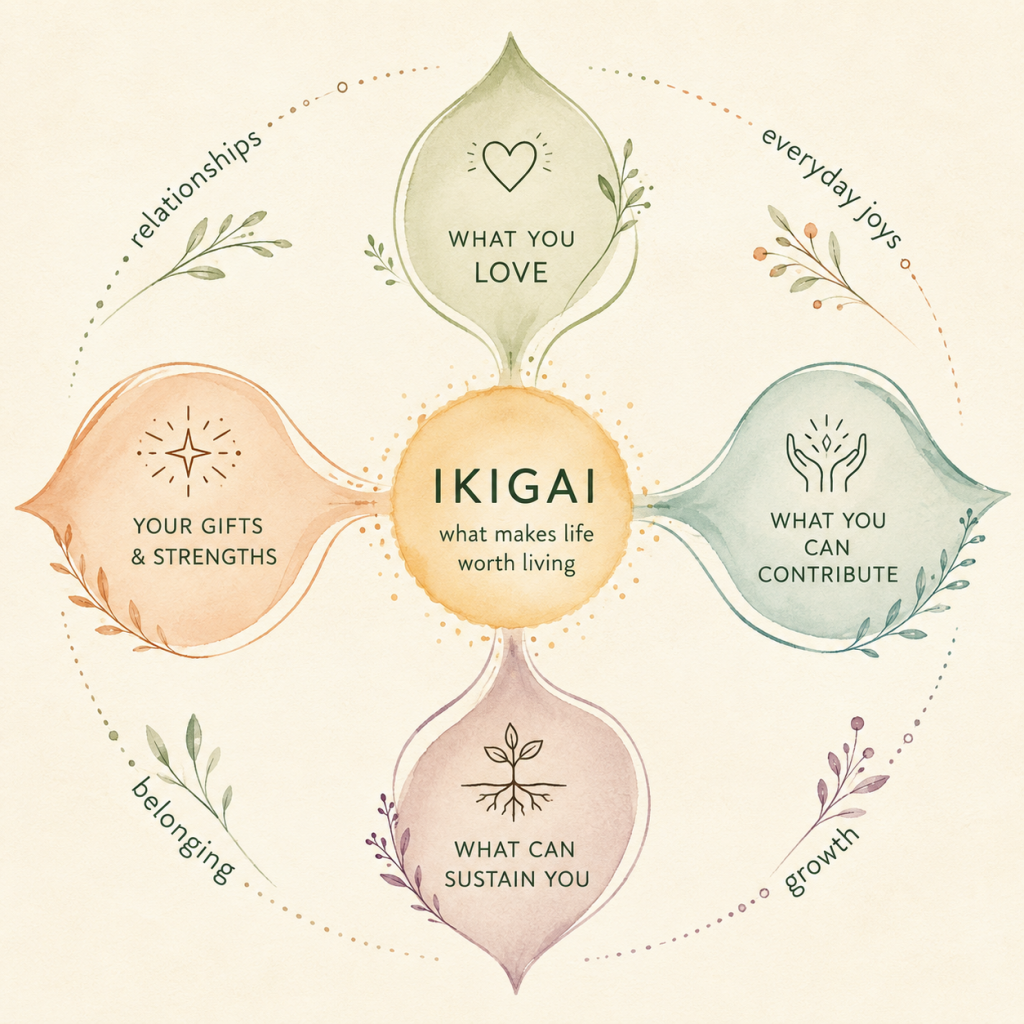
This is where ikigai offers something quietly radical. It invites us to turn away, for a moment, from comparison and external measurement and to become curious about our own life.
- What do I love?
- What strengths have I forgotten or dismissed?
- What genuinely sustains me?
- What can I contribute through being more fully myself?
We do not have to produce perfect answers. Ikigai is not an examination we pass or a single purpose we must discover. It can begin simply with noticing: the person or conversation that leaves us feeling energised, the ability another person values in us, or the small act that gives an ordinary day meaning.
Perhaps we do not find our ikigai by striving harder to become exceptional. Perhaps we move closer to it when we stop measuring ourselves against other people and begin listening again to what feels authentic, life-giving and meaningful within us.
From there, a different kind of life may gradually emerge—not necessarily more impressive from the outside, but more recognisably our own. It takes time and gentle reflection.
Therapy can provide a space to explore what matters to you beneath the expectations, roles and adaptations that may have shaped your life—and to consider how you might begin living in closer alignment with it.